
It's Make or Break Time
We need rain or else

Drought can be confusing, especially after what is considered to be a sizable precipitation event. In the last month, there was a big snow/ice storm from the central/southern Plains all the way to New England in late January, and many of us had a decent amount of rain on Valentine’s Day. During the latter event, I measured 3.25 inches of liquid at my house (just outside of Little Rock, AR). So, why am I bringing up drought?
Lesson learned: Arkansas was stricken by drought in 2005. On September 13th, D2 and D3 conditions were designated in sixty-three percent and fifteen percent of the state respectively. The remnants of Hurricane Rita dumped three to six inches of rain, and the drought was over by the 27th...or was it? Before long, signs of the drought returned (steadily worsening in October/November). We were back to square one in early December.
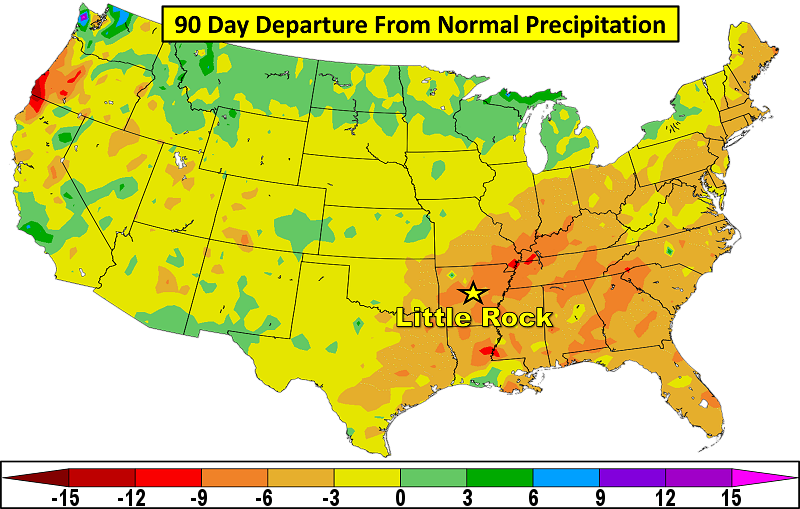
In the image: Departure from normal precipitation in the last ninety days ending on February 19, 2026.
We are way behind on precipitation in the last ninety days. By “we”, I mean areas from the southern Plains to the mid-Mississippi and Ohio Valleys eastward. Widespread three to six inch deficits are common. From the mid-South to the southeast United States, deficits exceed six inches at a lot of locations.
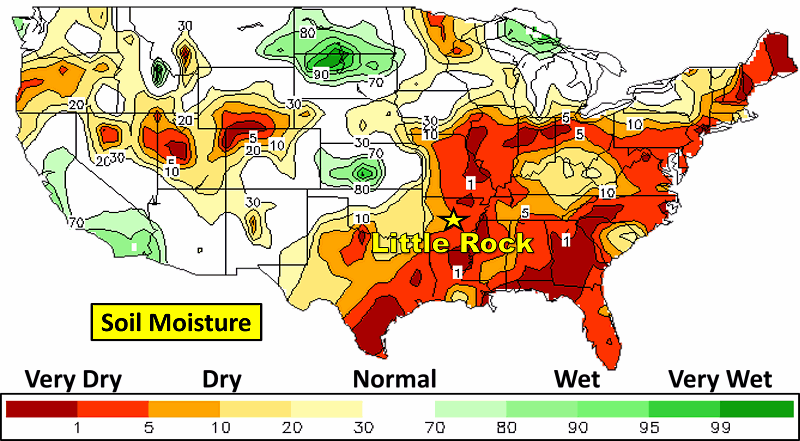
In the image: Soil moisture was well below normal (very dry) in the central Rockies, and from the southern Plains to the mid-Mississippi and Ohio Valleys eastward on February 18, 2026.
In the same areas, soil moisture is woefully low. Values are in the 5th percentile or less (30th to 70th percentile is normal), and drought is widespread. In Arkansas, ninety-nine percent of the state is experiencing drought (the most far-reaching this time of year since 2011). Extreme to exceptional drought (D3/D4 on the intensity scale) is common from central into northeast sections of the state. It doesn’t get much worse.
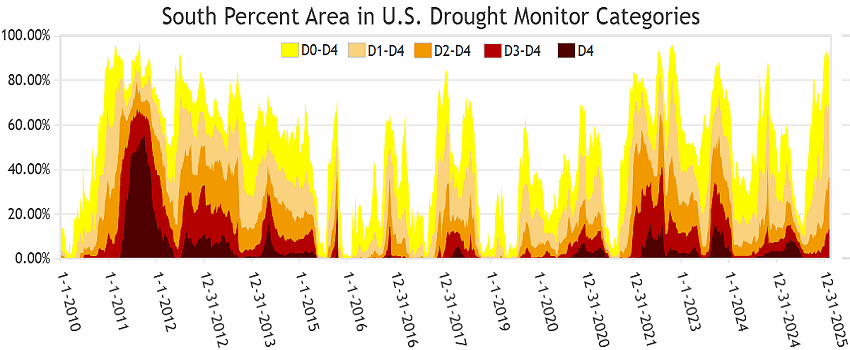
In the image: This is a drought timeline for several southern states (Arkansas, Louisiana, Mississippi, Oklahoma, Tennessee, and Texas) since 2010.
In surrounding states (including Louisiana, Mississippi, Oklahoma, Tennessee, and Texas), there is almost seventy percent drought coverage. Looking back at previous Februarys, the scope was about as high four years ago (in 2022), but the numbers were not as inflated again (going back in time) until 2011. That was the beginning of two of the most horrible drought years (through 2012) in recent memory.
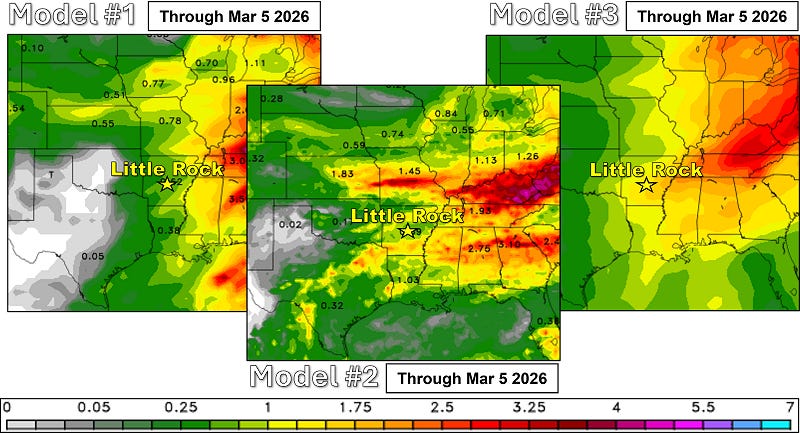
In the images: Models are showing the most significant precipitation east of the Mississippi River through early March, 2026. Data is courtesy of the College of DuPage.
Through the first week in March, forecast models are showing the most significant precipitation east of the Mississippi River (as of February 19th). Meanwhile, a dustier scenario is projected along portions of the Gulf Coast and much of the Plains.
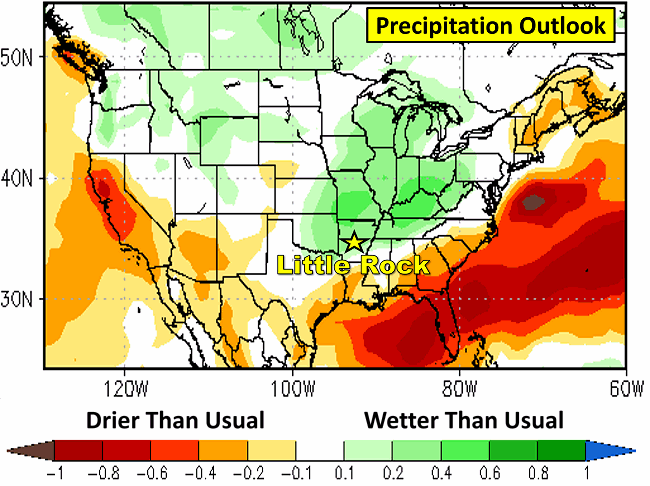
In the image: The forecast from the NMME (North American Multi-Model Ensemble) shows a wet signal from the Great Lakes through the Ohio, mid-Mississippi, and Tennessee Valleys into parts of the mid-South in March, 2026.
Longer range data (through the end of March/first few days of April) is indicating the same trends, with the potential for a deluge from the Great Lakes into the Ohio and Tennessee Valleys. There is an outside chance this wet scenario builds a little more to the west. This would be ideal here at home (in Arkansas) where we are teetering on feast or famine (it could go either way). This is a bad place to be given vegetation is emerging soon from dormancy, and ground water will disappear more quickly. It’s time to be concerned.
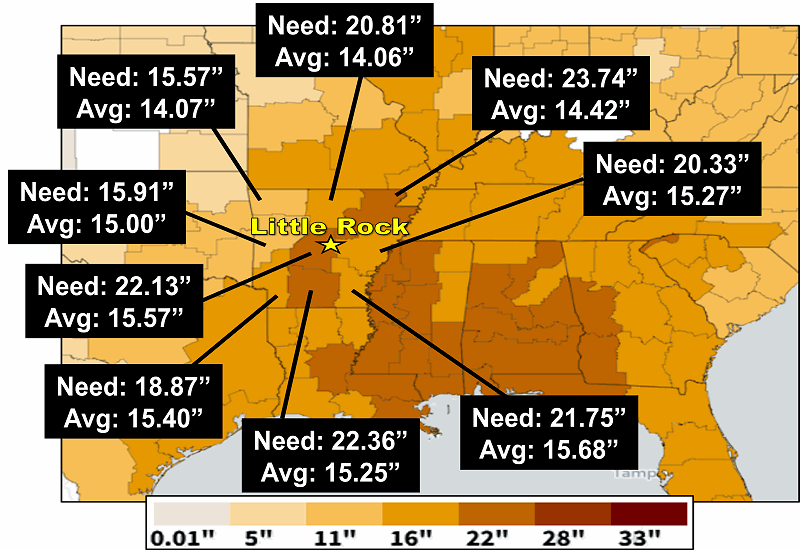
In the image: The amount of rain needed in the next three months (March through May, 2026) to eradicate drought conditions.
How much rain will it take to end the drought? From northeast into central and south central Arkansas (climate districts 3, 5, and 8), almost two feet of liquid (six to nine inches above average) is needed in the next three months. In the northeast counties, that would be a top five wet spring. While this could play out (anything is possible), it sounds far-fetched.